Acquiring Korean Manufacturing Franchises
A franchise is an established production system (which when followed produces the exact same product according to set specifications). One example of this is a McDonalds restaurant franchise (which is a system for producing an exact product right down to the thousands of a gram). When a company spends years in development of a product or system – then all of their combined development experience can be accessed through a franchise to produce the exact same product.
Korea has helped numerous nations abroad internationally and has even setup production operations in various nations so that these foreign countries can now produce Korean weapons systems for their own national defense. These production systems are part of a franchise system authorized by the Korean development companies to manufacture their Korean defense products and weapons systems under franchise agreement.
South Korean Industry Tempered by War
South Korea had been at war for over 70 years and therefore must be in a constant state of readiness. This war-preparedness has caused them to excel in war industries being able to mass produce items needed for defense while under an emergency time frame. This self-survival ability has translated into South Korea becoming a worldwide military arms provider.
Note: Clicking on the image below will open the associated stored video:
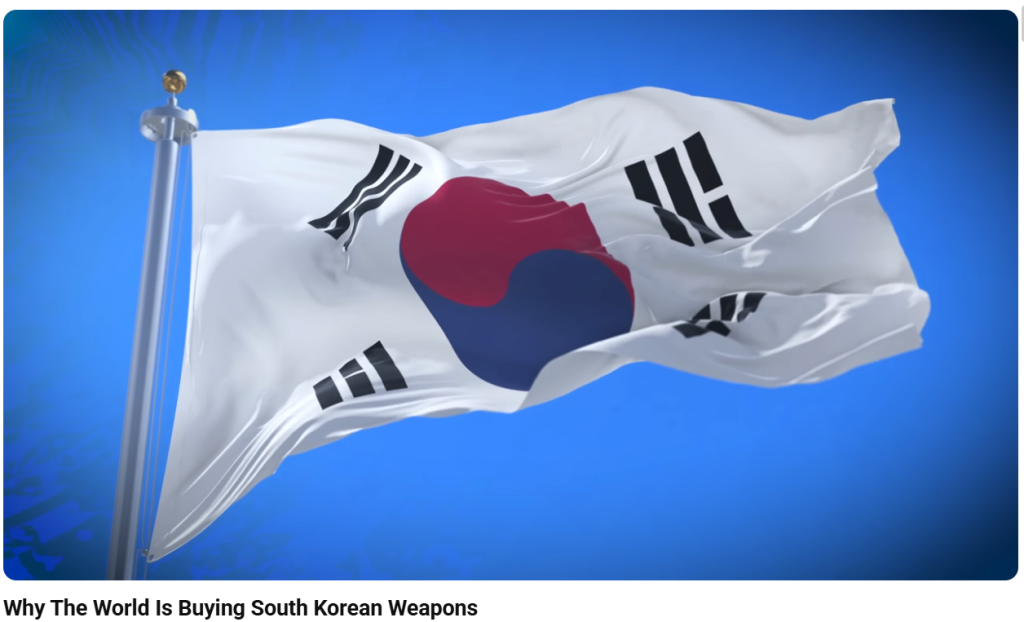
World arms spending has increased exponentially in recent times – as more and more nations feel a need for bolstering their own national defenses. There is currently a huge demand for fighter jets, military naval vessels, artillery, tanks, missile defense systems and drone warfare machines and related munitions. Nations are now willing to spend multiplied billions for defense but find that they lack options in the world defense products market. Due to urgency in defense, customers must now filter their defense spending decisions based on factors that include delivery times, and spare parts availability and product services. Many of the key “defense product provider” nations do not have the production capacity to meet the current demands for defense products. This is where South Korea really shines because they built a production system that can be scaled up on short notice. Their nation is under a constant threat of war with North Korea so South Korea has built a production system that can be quickly converted over into war materials production (if ever the need for it should arise).
Also large Korean companies have been producing export products in electronics and autos and computer chips and many other goods. The technical knowledge for producing these same products also has a wide application toward producing war goods. Aircraft and tanks and mobile artillery and missile defense systems all use the combined technology already being utilized within the Korean export industry. It is only a matter of combining these technologies to come up with new and effective weapons systems.
Korean Production Capacity Meets Defensive Needs Quickly
It is the Korean production capacity that allows them to offer fast delivery times. For example the Philippine Navy was in need of naval vessels for defense against the Chinese Navy. Korea delivered their first naval Frigate to the Philippine navy (a full five months ahead of schedule). Other ships will soon follow and this is great customer service. The Philippine Navy was desperate to upgrade their naval defenses against a hostile Chinese Navy that is making incursions into their own Philippine territorial waters. When customers are in trouble they cannot be put off with long wait times when they need their defense products right now. It seems the whole world is now gearing up for war and the demand for defense products is soaring.
But the most important thing is that South Korean can deliver their excellent defensive products quickly. South Korea also has provided their customers with the option of building weapons manufacturing facilities within their own nations. This means their customers can make their own parts at home and keep their Korean weapons systems running for decades to come.
Reports of the Korean-made missile defense systems being deployed by the gulf states show that the Korean missile defense systems were 96% accurate. Yet at the same time the Korean missile systems are many times lower in price than that which was manufactured within the overpriced US defense industry.
Currently South Korea is providing defense products for 23 countries (including the USA). The US does not have the production capacity or the available dry dock space to build their new destroyers so they have chosen South Korea to build their next generation naval vessels. Again the reason that South Korea is becoming a major world defense industry player is because they have the production capacity to deliver defense products without huge wait times.
Hyundai Purchase of Boston Dynamics
Boston Dynamics was created in 1992 as an offshoot of MIT. This company has accumulated over thirty years of robot engineering and robotics design experience. The company was acquired by Google in 2013 and then purchased by the Japanese investment company “Softbank” in 2017. Then in 2021 Korean Hyundai company purchased a controlling stake in this company.
Unless robots can be manufactured at scale – they cannot have any real meaningful use in serving humanity. But when Boston Dynamics was purchased by Google – there was no hope of robots being produced at scale because Google is only a software and data storage company without any manufacturing or production capabilities. When Softbank purchased the company there was also little possibility of robot production (occurring at scale) because Softbank is just an investment company and has no production or manufacturing capabilities. This is why when Boston Dynamics was purchased by Hyundai – this was a “match made in heaven” because Hyundai does have manufacturing capabilities and is already manufacturing autos at scale. All of the same principles used in auto manufacturing and assembly can also be applied to the mass production of robots.
Already Hyundai Motor Group (HMG) plans to deploy 25,000 Atlas – humanoid robots across Hyundai Motor and KIA manufacturing facilities with an annual production capacity of 30,000 Atlas robots by 2028. Over 300,000 actuator units will be produced annually at factories in the United States. It is these actuators that serve as critical robot components that function as joints and muscles of the robot.
Producing Robots at our Siberian Location
Note: Clicking on the image below will open the associated stored video:
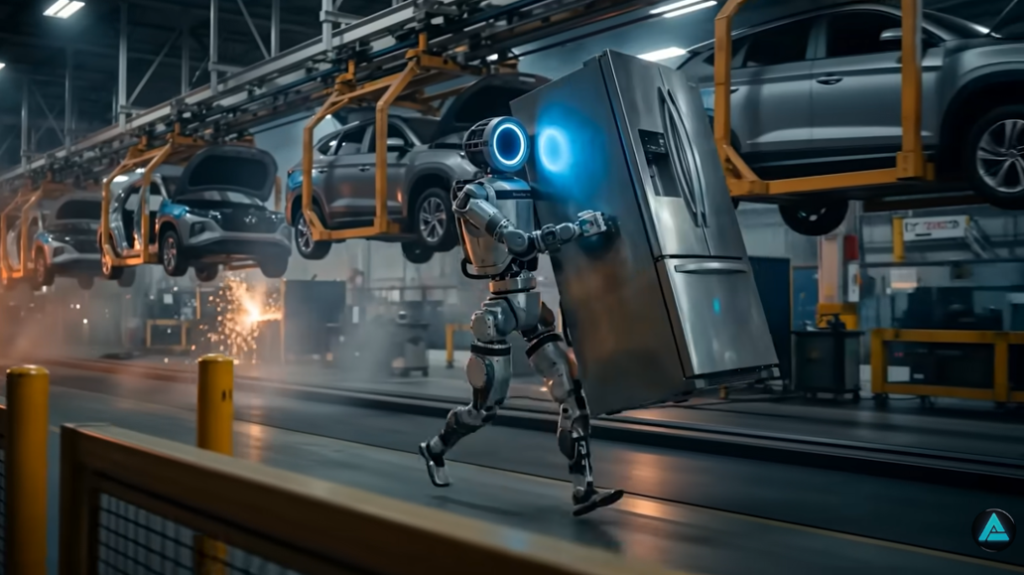
Our main objective in having robots is so that much of the current human work load can be handled by robots -thus giving our men the freedom they need to focus on what is important – such as family time and mentoring their children in godly moral values. What we want to do is establish a Korean franchise production system for the building of robots at our Kahatanga Siberia location so that these robots can be utilized within our various production factories.
See the link “Fostering Truth within AI and Robotics” for more details.